
Someone posted a comment recently that stuck with me: a lot of learners don't finish a course not because the content is bad, but because no one supported them when they got stuck.
It's true — and there's a harder problem sitting underneath it. Most admins can't support struggling learners, because they never see the struggle. They find out someone was lost only after that person is already gone.
Here's why. On most platforms, the only data an admin gets is completion. Done or not done. That's an outcome, not a view into the course. While a learner is confused, re-reading, guessing, or quietly deciding to give up, nothing surfaces. The dashboard stays green until the moment it doesn't — and by then it's a drop-off, not a save.
Imagine slide 6 of an onboarding course. Say forty percent of a cohort lands on it, sits for ninety seconds without touching anything, and quits. Something on that slide is losing people. On a completion-only platform, that whole event registers as a single number ticking down — no slide, no timing, no pattern. You'd know people left. You'd have no idea where, or why, or that they all left in the same spot.
So how is an admin supposed to know a course isn't working? Two ways, and both are broken.
They wait for feedback. But the learners who are frustrated rarely tell you. They don't fill out the survey — they close the tab. The feedback you do get comes from the vocal few, usually after the fact, usually too vague to act on: "the module was confusing." Which module? Which part? For whom? You're hearing from a self-selected minority, weeks late, about a problem you can no longer fix for the people it already cost you.
Or they guess. Completion dropped on Course 4 — was it the content, the length, a broken video, bad timing in the calendar, low motivation? Without any data from inside the course, every fix is a shot in the dark. You change something, wait a cohort, and hope. That's not course improvement. That's superstition.
The behavior is the feedback
The thing is, learners are telling you exactly what's wrong — just not in words. Their behavior is the feedback — the raw material of learning analytics — and it's being generated the whole time, by everyone, automatically:
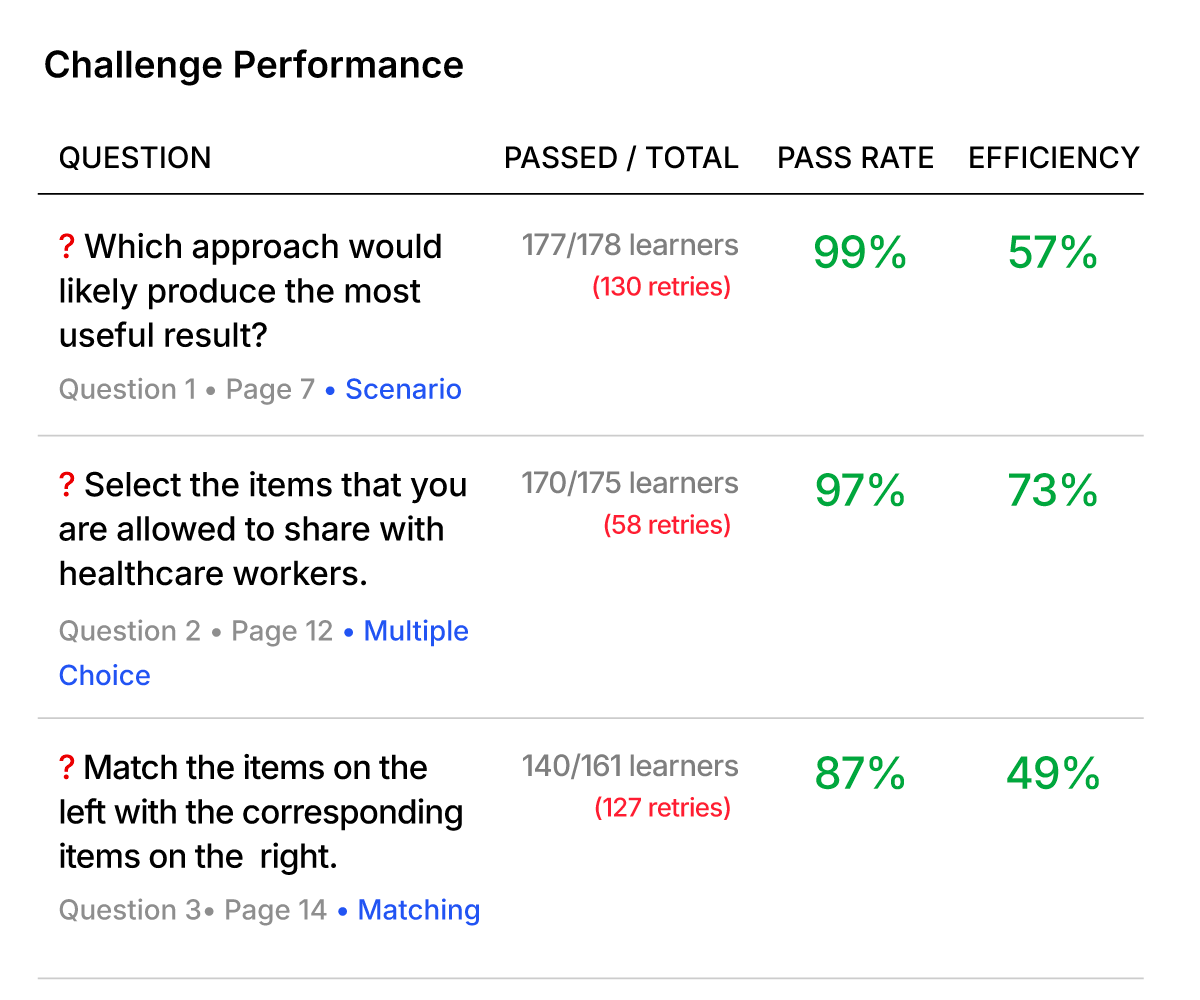
- Retries cluster on a specific question when that question is broken or the material never taught it. A few learners struggling is a coaching signal; most of them struggling is a content signal.
- Response times spike where people are confused — re-reading, second-guessing, stalling. Fast-and-right can indicate fluency; slow-and-eventually-right is fragile knowledge you'd never catch from a pass/fail.
- Drop-off points to the exact slide people abandon. Quitting early may signal a barrier — a confusing setup, a tech snag, content that never hooked. Quitting at the final assessment may signal confidence, not access. Same "incomplete" flag, opposite fixes.
You don't have to wait for a learner to volunteer any of this. It's already in the behavioral data — if the platform captures it. Most don't; they keep the endpoint and throw the process away, which is why their admins are stuck guessing.
Seeing it isn't enough — you have to act in time
REACHUM captures the full trail in the analytics — every attempt, response time, hesitation, and drop-off — as the learner moves through the course. And "captures the data" isn't the differentiator; plenty of tools bolt on an analytics dashboard or an xAPI feed. The difference is what happens next. Those signals land in batched, siloed reports you review later. REACHUM resolves them in near real time into a single readiness signal on the dashboard, tied to gated mastery — so struggle doesn't just get logged, it gets caught and acted on while the learner is still in the seat.
That changes what an admin can actually do. You can reach a learner who's stalling before they abandon, instead of emailing them a week after they're gone. You can spot the slide where half a cohort quit and fix it before the next cohort hits it — course improvement you can actually see in the results. In a regulated setting, you can flag at-risk learners and catch shaky knowledge before it walks onto the floor as a passed course.
That's the whole difference. Other platforms leave admins waiting for feedback that may never come, then guessing at fixes they can't measure. With the in-course data, the feedback is immediate, specific, and complete — the kind of real-time predictions that let action happen while it still matters.
Completion tells you who left. It never tells you why, and it never tells you in time to help. The visibility to support learners — and to actually improve a course instead of guessing at it — lives in the process, in the signals learners are already generating.
Frequently asked questions
Why isn't course completion data enough to support struggling learners?
Completion is an outcome, not a view into the course. It tells you who left, never why — and never in time to help. While a learner is confused, re-reading, or quietly giving up, a completion-only platform surfaces nothing until it's already a drop-off.
What in-course signals show that a learner is struggling?
Three, generated automatically by every learner: retries clustering on a question (a few learners is a coaching signal, most of them is a content signal), response times spiking where people are confused, and drop-off pinpointing the exact slide learners abandon.
Can response time reveal weak knowledge even when the answer is correct?
Yes. Fast-and-right can indicate fluency, while slow-and-eventually-right can signal fragile knowledge a pass/fail would never catch.
What's the difference between logging learning data and acting on it?
Many tools capture the data — an analytics dashboard or an xAPI feed — but land it in batched reports reviewed later. The difference is resolving those signals in near real time into a readiness signal tied to gated mastery, so struggle gets caught while the learner is still in the seat.
If your team is still working off completion reports and waiting for survey responses, it's worth seeing what the process data actually looks like.