

Asking a good open-ended question is one of the most undervalued skills a manager or trainer has. It is the difference between confirming what you already assumed and finding out what your team actually thinks.
Open-ended questions do more than gather information. They ask people to think, and then to say what they think out loud. That is a larger request than it sounds, and it fails more often than most leaders notice — usually not because the question was badly worded, but because answering honestly felt expensive.
What Makes a Question Open-Ended
Open-ended questions start with Why, How, or What. They invite a considered answer rather than a yes, a no, or a pick from a list. They ask the person to pause, reflect, and put something of their own into the reply.
The useful distinction: closed questions gather answers. Open questions gather insight.
Open-Ended vs Closed-Ended
Both have a job, and the mistake is using one where you needed the other.
- Closed-ended: quick, definitive, comparable across a group. “Did the rollout hit the deadline?” Right when you need a number, a decision, or a count.
- Open-ended: elaborative, unpredictable, revealing. “What slowed the rollout down?” Right when you do not yet know what you are looking for.
Closed questions are efficient precisely because they constrain the answer. That efficiency is the problem when the thing you need to learn is outside the options you thought to offer.
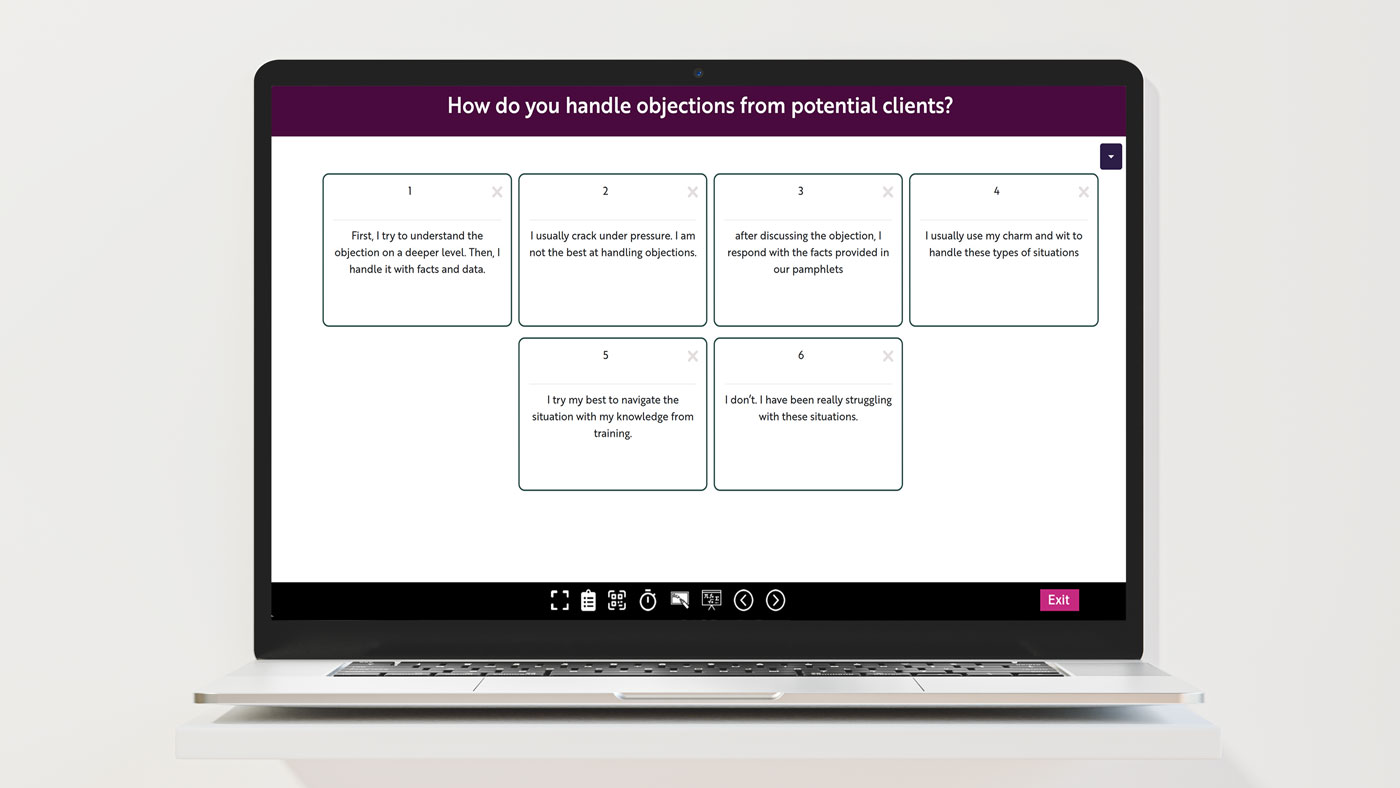
Six anonymous answers to one open question. Note the two that admit struggling — those are the answers a round-table never produces.
Questions Worth Asking at Work
Team and culture
- What are the best and worst parts of our meetings, and why?
- How would you describe the way we work to someone about to join?
- What would help us keep the people we cannot afford to lose?
- If you ran this meeting, what would you do differently?
Brainstorming
- How would you approach this if the budget were half?
- What is the most effective solution nobody has proposed yet?
- In your experience, what makes a brainstorm actually work?
Feedback on training
- How would you explain this to someone who missed the session?
- If you could redesign this module, what would you cut?
- What is the one thing here you will actually use next week?
Career conversations
- What skills do you want to develop that this role is not stretching?
- How do you see your path over the next couple of years?
- What support would make the biggest difference right now?
- Which part of the work motivates you most?
What Separates a Good Open Question From a Vague One
Open-ended is not the same as unfocused. The questions that produce useful answers tend to be:
- Specific. Broad questions get broad answers. “How’s it going?” gets “fine.”
- Non-leading. The phrasing should not signal the answer you are hoping for.
- Aimed at thinking, not just facts. Verbs like think, feel, and believe ask for a judgment rather than a recall.
Small rewrites change what comes back:
- Instead of “Why did you do that?” — which carries an accusation — ask “What influenced your decision?”
- Instead of “Do you like this project?” ask “What parts of this project do you enjoy?”
- Instead of “Any questions?” — which reliably gets silence — ask “What is still unclear?”
Where They Earn Their Keep
- Live sessions: to open a real discussion rather than a compliance check.
- Surveys: to get the why underneath a score you already have.
- Brainstorms: to widen the field before narrowing it.
- Feedback loops: to learn how a change actually landed.
The Part Most Teams Get Wrong
A well-phrased question still gets a hollow answer if the person answering thinks it will cost them something.
Amy Edmondson’s study of 51 work teams found that psychological safety — the shared belief that a team is safe for interpersonal risk-taking — predicted learning behaviour, while team confidence did not. Her published research has held up across two decades and a lot of industries. People learn out loud only where speaking up feels survivable.
In a training room the cost is usually embarrassment in front of peers. In a hierarchy it is embarrassment in front of the manager who writes your review. Both produce the same outcome: the room goes quiet, and the trainer concludes everyone understood.
Anonymity removes that cost directly. Ask a group of reps how they handle objections with names attached and you get the version they think you want to hear. Ask the same question anonymously and you get “I usually crack under pressure.”
The uncomfortable answer is the useful one. A rep who admits they are struggling has just told you exactly where to spend your coaching time. The polished answer tells you nothing you can act on.
Practical Tips
- Start small. Move a session from closed to open gradually rather than opening with the hardest question you have.
- Give people a way to answer without their name on it. This single change usually does more than any rewording.
- Tailor to the room. A question that works with a team of five fails with a room of two hundred, and vice versa.
- Watch what you can observe. Response depth, hesitation, and how many people answer at all are signals in their own right — often more honest than the content of the answers.
- Follow the thread. The value is rarely in the first answer. It is in the question you ask about the answer.
The Point
Open-ended questions are how you find out what is actually happening in a team, a session, or a rollout — the parts that no dashboard reports and no completion rate captures. They sit at the top of any hierarchy of interaction, because they ask the most of the person answering.
Which is exactly why the question is only half the work. The other half is building a session where answering honestly is the easy thing to do. Get both right and people will tell you things you did not know to ask about. Get only the first right and you will collect a lot of well-phrased silence.
Frequently asked questions
What is an open-ended question?
A question that invites a considered, elaborated answer rather than a yes, a no, or a selection from a list. Open-ended questions usually begin with what, how, or why, and ask the respondent to supply their own reasoning.
What is the difference between open-ended and closed-ended questions?
Closed-ended questions produce quick, comparable answers and work when you need a number or a decision. Open-ended questions produce unpredictable, detailed answers and work when you do not yet know what you are looking for.
What are good open-ended questions to ask a team?
Ask what would change if they ran the meeting, how they would describe the culture to a new joiner, what slowed a project down, or what support would make the biggest difference to them right now. Specific beats broad every time.
Why do people give shallow answers to open-ended questions?
Usually because answering honestly feels risky rather than because the question was poor. Research on psychological safety shows people share candidly only where speaking up feels survivable — which is why anonymous response tends to produce markedly more honest answers.