
Microlearning works. That's not a claim — it's a settled question. The International Journal of Education Research found that bite-sized training modules make learning 18% more effective. Our own clients have cut training timelines from weeks to days and sustained 85–88% attention rates in sessions that used to lose people after twelve minutes.
We've been building microlearning experiences for almost two decades. The methodology is proven: deliver a short message, reinforce it with an activity, discuss the results, show the progress. Repeat. It works for sales reps, management development, golf enthusiasts, and Department of Defense personnel. It works across every demographic we've tested from ages 12 to 73.
So the question isn't whether microlearning works. The question is: what happens when you add AI?
The answer is that AI microlearning doesn't just make training faster. It makes it personal, adaptive, and for the first time, genuinely conversational.
The Limits of Traditional Microlearning
Even great microlearning has constraints.
The "reinforce" step — the activity after the message — has traditionally been limited to what a designer builds in advance. Quizzes, drag-and-drop exercises, matching games. They work. But they follow a script. Every learner gets the same scenario, the same choices, the same feedback. The person who needs more skill on handling pricing objections gets the same training as the person who's already adept.
Creating those activities takes time, too. A course designer needs to anticipate every path, write every response, build every branch. That's why, even with microlearning's 300% time savings over traditional methods, companies still face a bottleneck at the content creation step.
AI removes both constraints.
How AI Transforms Each Step of Microlearning
1. Prepare the Content Faster
AI doesn't replace the presenter. What it does is collapse the time between "we need training" and "the training is ready." Upload a product sheet, a compliance update, a new pricing structure — and AI will accelerate the process so that it takes minutes, rather than weeks, to create an effective training module. That speed only pays off when the underlying material is yours to change — which is why content ownership comes first.
For sales teams this is the difference between attacking at market speed and crawling to catch up.
2. Reinforce with Role-Plays
This is where AI microlearning changes the game.
Instead of a scripted quiz, learners step into conversations. AI-powered role-plays respond the way real customers, patients, or stakeholders would — with objections, follow-up questions, and curveballs that no multiple-choice exercise can replicate.
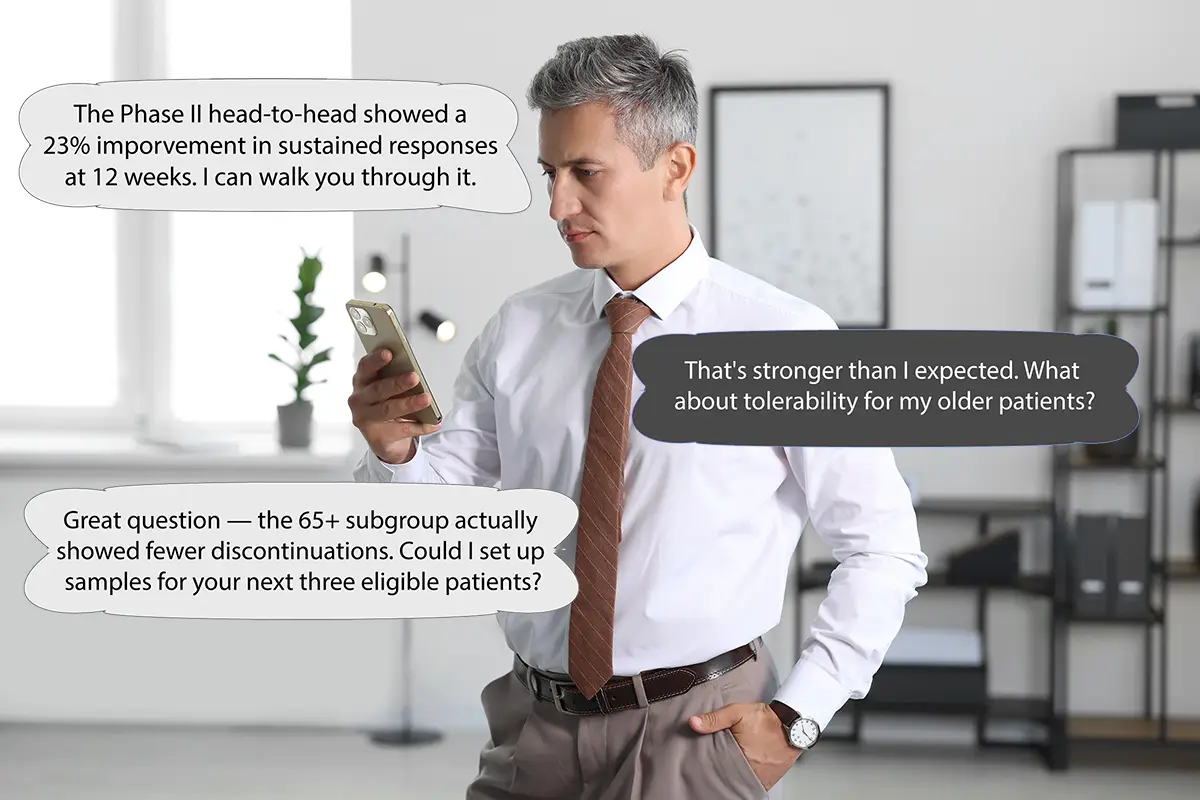
A pharmaceutical rep doesn't just answer "What is the mechanism of action?" on a quiz. They practice explaining it to a skeptical physician who pushes back on efficacy data. A retail associate doesn't just click the right response about return policies. They navigate an upset customer who wants an exception.
The reinforcement step goes from recall to readiness. That's not a minor upgrade. It's the difference between knowing the answer and being able to deliver it in a high-pressure situation.
3. Discuss with Real-Time Intelligence
In live microlearning, the discussion step is where trainers close learning gaps. They look at response data and address what the group got wrong.
AI makes this step sharper. Instead of scanning a bar chart, trainers get instant analysis: which concepts are landing, which aren't, and — critically — which individuals need follow-up. The data moves from descriptive to diagnostic. You're not just seeing that 40% of the group missed a question. You're seeing why they missed it and what to do about it before the session ends.
4. Show Progress That Means Something
Traditional training measures completion. Check the box and you're done.
AI-driven microlearning measures capability. Can you handle the conversation? Can you adapt when the situation shifts? Role-play performance data doesn't just tell you someone watched a video. It tells you whether they're ready.
For the people writing the checks — the sales leaders, operations managers, franchise owners — that distinction is everything. Completion is a cost. Capability is evidence of readiness, the proof of learning ROI.
Why "AI Microlearning" Is Taking Off
Companies are searching for AI microlearning at accelerating rates because they're feeling the squeeze from two directions simultaneously.
On one side, training needs are increasing. Product cycles are shorter. Compliance requirements are expanding. Turnover means constant onboarding. On the other side, nobody has time. Sales teams can't sit through a two-hour webinar. Frontline workers can't leave the floor for a half-day workshop. Hybrid and remote employees are scattered across time zones.
AI microlearning solves both problems at once. It compresses content creation from weeks to minutes. It personalizes reinforcement so each person practices what they actually need. And it delivers proof — not completion certificates, but readiness data that shows whether someone can do the job.
What to Look For in an AI Microlearning Platform
Not every tool calling itself "AI-powered" delivers real AI microlearning. Here's what separates platforms that use AI as a feature from platforms built on AI microlearning principles:
Activity, not just content. If the AI only generates slides or text, you're still in passive consumption territory. The AI should power the reinforcement — the role-plays, simulations, and practice that move knowledge into performance.
Live and on-demand. AI microlearning should work in both modalities. Trainers should be able to run live sessions with real-time data and deploy the same content as self-paced experiences. Limiting it to one or the other misses half the value.
Real analytics. If the platform can't tell you who's ready and who isn't, the AI is decorative. You need decision-grade data: not just scores, but patterns, gaps, and trends that inform business decisions.
Cost that makes sense. Most platforms ask for marriage on the first date — annual contracts, five-figure implementation fees, and per-seat pricing that punishes you for growing your team. We have a different philosophy. Start small. See results. Scale when you're ready. REACHUM's plans begin at $120/month per team — not per person — with white-glove onboarding and zero setup costs. No annual commitment. We invest in relationships that scale along with your business. Add in a free trial and you are free from risk. You subscribe when you have proof of value.
The Bottom Line
Microlearning is the most effective training methodology we've seen in four decades of building learning experiences. AI doesn't replace it — AI unleashes it. Faster content creation. Smarter reinforcement. Sharper analytics. And proof of capability that goes beyond checking a box.
The companies figuring this out now aren't just training better. They're building teams that practice to win during conversations that haven't happened yet. The fastest place to apply this is the content you already own — turning narrated PowerPoint into interactive lessons that command learner attention.
Frequently asked questions
What is AI microlearning?
Microlearning delivers short, focused lessons reinforced by practice. AI microlearning adds real-time adaptation and conversational practice on top — so each learner drills what they specifically need, and content that used to take weeks to build is ready in minutes.
How is AI microlearning different from regular microlearning?
Traditional microlearning reinforces a lesson with a fixed quiz or drag-and-drop that every learner sees identically. AI replaces the scripted activity with role-plays that respond like real customers or stakeholders, moving reinforcement from recall to readiness.
Does microlearning actually work?
Yes. Research in the International Journal of Education Research found bite-sized modules make learning about 18% more effective, and it holds across ages and roles. AI makes it faster to build and more personalized — not more effective in principle.
What should I look for in an AI microlearning platform?
AI that powers the practice, not just generates slides; support for both live and on-demand delivery; analytics that show who's ready rather than who merely finished; and pricing that lets you start small without an annual contract.